
Guild Systems
Demo Center
Guild ControlPlane
Context
Story
Demo
Value
Close
Evidence0
Context · Stop 1 of 11
Introduction
Section: ContextAudience: ExecutivePersona: ExecutiveMode: demoData: Simulated
Evidence: 0
HarnessContext — all three layers wrap every AI interaction
Guild Systems×IBM
Project Guild ControlPlane

The Case for Governed Enterprise AI

From AI Experimentation to Controlled, Observable, Defensible Enterprise Value.

Audience lens
What you'll learn
~30 min
  • The seven CIO questions and how ControlPlane answers each one
  • The three-part harness: govern what runs, test what ships, build with the same controls
  • How policy is enforced at runtime — not just on paper
  • How evidence is sealed per AI interaction
  • The engagement paths from assessment to enterprise transformation
Why it matters

Enterprises lack a single pane of glass that traces AI from request to outcome. ControlPlane provides that visibility, control, and evidence in one place.

What you'll be able to do

Walk a prospect through the seven answers, the three-part harness, and the three engagement paths.
SIMULATEDDemo environment \u2014 no production integrations
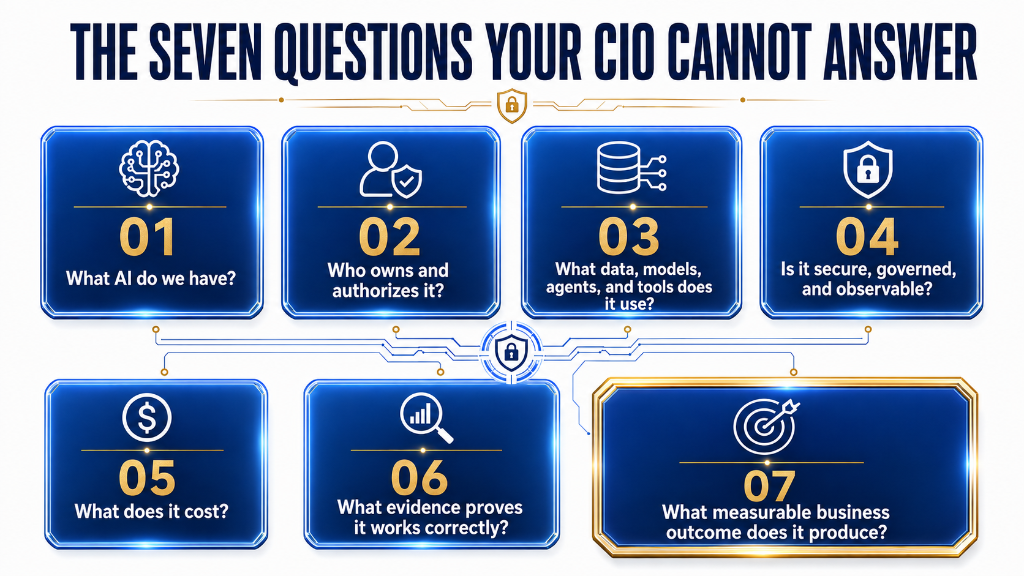
The Seven Questions Your CIO Cannot Answer
From Questions to Answers
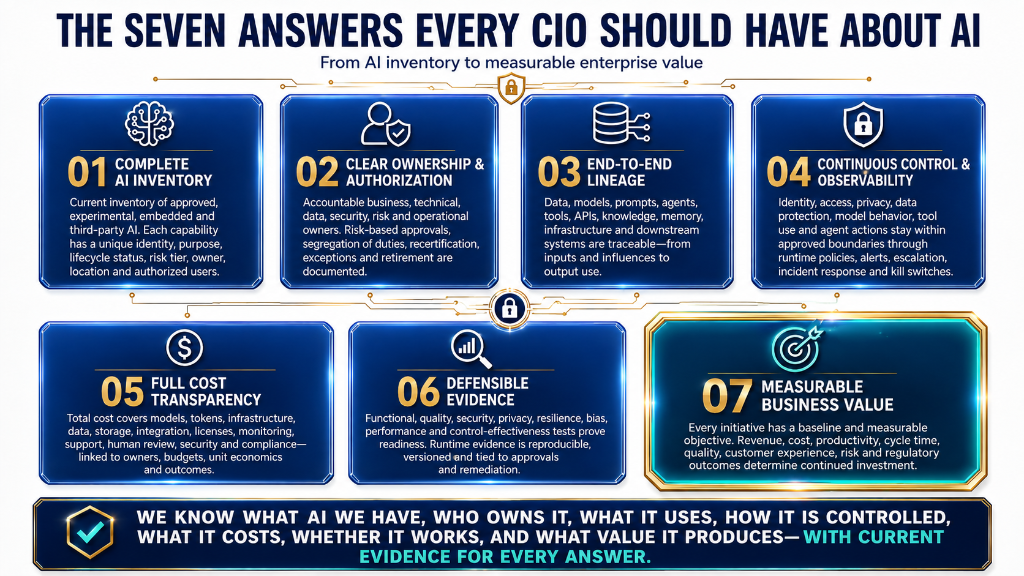
The Seven Questions expose a visibility gap every enterprise now faces. The Seven Answers are not aspirational claims — they are the operational output of a single, governed control plane that embeds Governance, Security, and Observability directly into the AI execution path. Guild ControlPlane turns each question into a live, evidence-backed answer.
The Seven Answers Every CIO Should Have About AI
What Governance Makes Possible

Five business advantages of implemented governance

Effective governance gives organizations a deeper understanding of their processes, greater transparency, clearer accountability, stronger economics, and better preparation for disruption. These advantages emerge when ownership, controls, evidence, and continuous improvement become part of everyday operations.

ILLUSTRATIVE
Click the infographic to enlarge.
Implementation
Map activities, decisions, data, dependencies, handoffs, owners, and exceptions. Compare the documented process with actual execution to identify bottlenecks, errors, and rework.
Accountability
Process owner, supported by operations and data owners.
Evidence
Process maps, execution traces, exception records, improvement decisions, and before-and-after measurements.
Measures of progress
Process coverage, cycle time, error rate, rework, and verified improvements.
Implementation
Audience-appropriate reporting makes performance, commitments, risks, decisions, and unresolved issues visible. Traceable sources, reporting freshness, and clearly stated limitations matter.
Accountability
Business sponsor and reporting owner, with appropriate client-facing responsibility.
Evidence
Source-linked reports, decision records, commitments, and exception updates.
Measures of progress
Reporting completeness, freshness, traceability, and overdue commitments.
Client visibility must respect confidentiality and authorized access.
Implementation
Assign responsibilities according to capability, capacity, risk, and authority. Cover named human accountability, bounded agent permissions, approval thresholds, separation of duties, escalation, backup coverage, and revocation.
Accountability
A named human owner for every governed process.
Evidence
Responsibility assignments, delegation records, authorization decisions, approvals, and escalation logs.
Measures of progress
Ownership coverage, approval delays, unauthorized actions, workload distribution, and unresolved escalations.
Implementation
Total operating cost includes models, infrastructure, integration, oversight, rework, and support. Cover cost attribution, budgets, demand scenarios, capacity planning, forecasting, and investment prioritization.
Accountability
Business owner and finance or FinOps owner.
Evidence
Cost allocations, financial assumptions, budgets, forecasts, and benefits reviews.
Measures of progress
Cost per successful outcome, forecast variance, budget variance, capacity utilization, and realized benefits.
Optimization must maintain required quality and risk controls.
Implementation
Critical dependencies, incident authority, containment, suspension, access revocation, human fallback, stakeholder communications, recovery, and authorized restart. Include readiness for failure of governance components themselves.
Accountability
Service owner, incident commander, and designated recovery authority.
Evidence
Response plans, dependency maps, drill results, recovery records, and corrective actions.
Measures of progress
Detection, containment, and recovery times; tested fallback coverage; and closure of lessons learned.
From Advantage to Implementation

These five advantages depend on practical implementation: identify the required controls, assign owners, implement and test them, retain evidence, approve operation within clear conditions, and review the results.

Explore Responsible AI in Practice
The Three-Part Harness

Beneath the Seven Answers sits a single unifying structure — the harness. Guild ControlPlane wraps three co-equal layers around every AI interaction: govern what runs, test what ships, and build with the same controls.

Governance HarnessSIMULATED

Runtime policy gates, PII redaction, HITL approval, and sealed evidence — wrapped around every AI request.

Eval / Test HarnessPROPOSED MVP

Automated quality scoring, retrieval precision, and citation verification that gate AI outputs before they reach users.

PDLC HarnessPROPOSED MVP

AI-assisted build, test, and ship — code generation and review under the same governance and evidence controls.

What You Leave With
A clear picture of where your AI investments stand today
A governed path from experimentation to controlled production
Evidence-backed answers to the seven CIO questions
A concrete next step: the Guild ControlPlane Assessment
The decision we are asking you to make today

Before we show the demos, we need your decisions on seven items. These turn today's session from a review into a commitment.

1Approve ControlPlane as a joint solution candidate
2Confirm the primary buyer
3Confirm the entry offer
4Name IBM validation owners
5Agree 2–3 target accounts
6Name commercial owners
7Agree the first 30-day actions